Showing posts with label Network Virtualization. Show all posts

Saturday, September 20, 2014

Virtualization at Scale – Part 3: Real-World Integration, Cost Considerations, and the Road Ahead

September 2014    Reading Time: 13 minutes

Integrating Virtualization with Legacy Systems

One of the most significant challenges in 2014 is that few enterprises have the luxury of starting from a blank slate. Most organizations have substantial legacy systems in place, including mainframes, proprietary applications, and monolithic systems with rigid dependencies. Integrating modern virtualization solutions into such environments requires detailed planning, robust abstraction layers, and often, a willingness to accept some technical debt in the short term.

Virtualization introduces a new operational paradigm, especially when integrating with hardware-bound or OS-tied services. Tools like VMware vSphere and Microsoft Hyper-V offer pass-through capabilities, but legacy workloads often lack the compatibility or performance headroom to take full advantage. Strategies such as encapsulating legacy apps within virtual machines, segmenting traffic via VLANs or virtual firewalls, and setting clear boundaries between virtual and non-virtual workloads help mitigate risk.

Hybrid Infrastructure: Bridging On-Prem and Cloud

While full cloud adoption is still rare in 2014, hybrid IT is a major architectural goal. Enterprises are looking to extend their data centers by leveraging cloud platforms such as Amazon Web Services or Microsoft Azure. This shift demands that virtualization platforms not only support internal scaling but also federation with cloud-native services and APIs.

Virtualization administrators must now understand cloud bursting, image portability (e.g., OVA/OVF formats), and cross-platform networking challenges. Tools like VMware vCloud Connector and OpenStack bridges are emerging to facilitate hybrid workloads. Monitoring, logging, and billing consistency between cloud and on-prem must also be addressed before production readiness.

Cost Models and Licensing Strategies

Virtualization, while reducing hardware costs, often introduces new financial complexity. The shift from CAPEX to OPEX, per-socket to per-core licensing, and bundled feature tiers make vendor comparison difficult. In 2014, VMware continues to dominate enterprise adoption, but the pricing pressure from Microsoft, Citrix, and Red Hat is growing.

Smart organizations are building internal TCO calculators to weigh the long-term implications of vendor lock-in, support tiers, and feature availability. They also analyze hidden costs such as backup licensing, DR configuration, and orchestration tool integration. Decisions should not be made solely on hypervisor cost — management stack and ecosystem compatibility matter equally.

Workforce Skills and Operational Readiness

Virtualization transforms the role of the traditional system administrator. Instead of racking servers or manually patching OS images, today's admins must understand APIs, templating, storage abstraction, and virtual switching. The most successful teams in 2014 are upskilling their staff in scripting (PowerShell, Bash), orchestration tools (vCenter Orchestrator, SCVMM), and even early DevOps principles.

Skills gaps are acute in storage and network virtualization. As VXLAN overlays, iSCSI multipathing, and software-defined storage rise, the need for cross-functional training becomes urgent. Companies are investing in lab environments and internal knowledge transfers to bring operations up to par before scaling further.

Security, Compliance, and Risk in Virtualized Environments

Security in virtualized environments has matured since early implementations, but gaps remain. Visibility across East-West traffic, sprawl of VMs, and lack of traditional perimeter make enforcement complex. Tools like vShield and third-party firewalls (e.g., Trend Micro Deep Security) are gaining popularity.

Regulatory compliance (HIPAA, SOX, PCI-DSS) is a recurring challenge. Auditors must be educated on hypervisor architecture, VM mobility, and virtual storage zoning. Segmentation strategies such as micro-segmentation are still in their infancy in 2014 but are being explored to enforce policies closer to the VM level. Detailed documentation, regular reviews, and change control help ensure auditability and reduce legal exposure.

Performance Monitoring and Capacity Planning

As VM density increases, so does the challenge of maintaining performance. Traditional monitoring tools are often insufficient for dynamic environments. Organizations are turning to performance analytics platforms like vRealize Operations (formerly vCOPS), Veeam ONE, and open-source tools like Nagios with virtualization plugins.

Capacity planning becomes a predictive exercise — admins must consider VM sprawl, memory ballooning, IOPS trends, and storage latency. Automated provisioning and right-sizing tools help but require solid baselines. SLA expectations should be redefined to reflect shared resource models.

The Road Ahead: Future Trends and Strategic Considerations

Looking beyond 2014, several trends are shaping the virtualization landscape:

  • Containerization: Technologies like Docker (1.0 released in 2014) are beginning to offer OS-level virtualization that challenges traditional VM paradigms.
  • Hyperconverged Infrastructure (HCI): Vendors like Nutanix and SimpliVity are gaining traction by tightly coupling compute, storage, and networking.
  • Policy-Driven Management: Orchestration tools are shifting from manual inputs to declarative state configurations and service catalogs.
  • Network Virtualization: Solutions like VMware NSX and Cisco ACI are gaining interest but remain complex to deploy and scale in real-world settings.

Enterprises must balance experimentation with maturity. The smartest move may be to build out a pilot cluster for each new technology, document operational challenges, and then scale only when confidence and tooling maturity allow.

Conclusion

Virtualization at scale is a journey, not a product. As this series concludes, it’s clear that organizations must treat virtualization as a strategic pillar — integrating with business objectives, enabling agility, and reducing time to market. Architecture, operations, and governance must align, and every layer — from hardware to application — must be designed with virtualization in mind.

Eduardo Wnorowski is a network infrastructure consultant and virtualization strategist.
With over 19 years of experience in IT and consulting, he delivers scalable solutions that bridge performance and cost efficiency.
Linkedin Profile


Friday, September 20, 2013

SDN Deep Dive Part 3: Challenges and the Future Landscape

September 2013 | Estimated reading time: 10 minutes

Overview

Software-Defined Networking (SDN) has reshaped the way we think about network architecture. After exploring the concepts and architectures in Part 1 and diving into practical deployment models in Part 2, we now explore the real-world challenges SDN faces in 2013 and what the road ahead might look like.

Challenge #1: Industry Maturity

While OpenFlow and SDN have garnered significant attention, the industry is still in a state of flux. There is no single unified SDN standard, and interoperability between vendors remains a major barrier. Traditional hardware vendors are adapting slowly, while startups and open initiatives push forward aggressively.

For SDN to gain mainstream traction, clearer standards must emerge. The Open Networking Foundation (ONF) is taking steps, but competing agendas slow progress. In production environments, CIOs and network architects are wary of deploying technology that lacks maturity and long-term vendor support.

Challenge #2: Performance and Scalability

Centralized controllers are core to SDN, but they also pose potential performance bottlenecks. Latency introduced by control-plane-to-data-plane communications must be minimized. Scalability across hundreds or thousands of devices requires hierarchical control models, and while proposed, these are not yet proven in the field.

Additionally, data centers using high-throughput architectures with 10GbE or 40GbE interfaces raise concerns about the controller’s ability to respond in time-sensitive operations. Researchers are exploring distributed controller clusters to address this, but adoption is slow.

Challenge #3: Reliability and High Availability

Networks must be resilient. Placing intelligence in a centralized controller raises questions: What happens if the controller fails? How do we maintain state, ensure consistency, and resume operations quickly?

Current SDN controller platforms like Floodlight and NOX are improving support for clustering and failover, but these features are still experimental in many deployments. HA (High Availability) mechanisms, traditionally native to network hardware, now must be reengineered in software.

Challenge #4: Security Implications

SDN opens both opportunities and vulnerabilities. While it offers centralized policy enforcement, a compromised controller can be catastrophic. Attackers who gain access to the SDN control layer could redirect traffic, disable services, or inject malicious flows across the network.

Furthermore, APIs used to interface with the controller (e.g., RESTful APIs in OpenDaylight) must be secured with strong authentication and access control mechanisms. In 2013, controller security is still an underdeveloped area, requiring greater industry focus.

Challenge #5: Organizational Resistance

Change in IT is not just technical—it’s cultural. Many networking teams are deeply familiar with CLI-driven device configurations, vendor-specific features, and decades of best practices. Moving to SDN requires rethinking network design, tools, and roles.

For example, network engineers must now collaborate with developers and DevOps teams to write automation scripts and manage network APIs. This cultural shift—toward programmability and abstraction—is slow and met with skepticism in many traditional enterprises.

Challenge #6: Integration with Legacy Infrastructure

Few organizations are in a position to replace their entire network stack. SDN must coexist with legacy systems, often requiring overlay networks (like VXLAN or NVGRE) or hybrid deployments.

This raises questions around flow visibility, troubleshooting, and management. Bridging physical and virtual environments introduces complexity, especially in mixed-vendor environments where APIs and control mechanisms differ widely.

Forecasting the Future: 2014–2020

Despite these challenges, SDN’s trajectory remains promising. Here’s what we expect to see in the coming years:

  • Controller evolution: Maturity and consolidation around a few robust, open-source controller platforms (e.g., OpenDaylight).
  • OpenFlow 1.4+ adoption with broader hardware support and new feature sets.
  • Integration with orchestration tools like OpenStack, Puppet, and Chef for full-stack automation.
  • Northbound API standardization to enable application portability and development.
  • Wider SDN trials in universities, financial firms, and telecom providers.

As with all foundational shifts, progress will be incremental. SDN in 2013 is comparable to server virtualization in 2003: full of potential, but not yet ready for mission-critical, widespread production in most enterprises.

Looking Beyond SDN: Toward NFV and Intent-Based Networking

Already in 2013, we see the emergence of **Network Functions Virtualization (NFV)**—the idea of abstracting network services (like firewalls, load balancers, WAN optimizers) from dedicated appliances and running them on general-purpose x86 servers.

Similarly, **intent-based networking** is being discussed in academic circles. This would allow administrators to describe what the network should do, and let the SDN system implement the logic automatically—a powerful idea, but still largely conceptual at this stage.

Conclusion

SDN is not a passing trend. The challenges are real, but so are the benefits. Like any transformative technology, it requires time, refinement, and ecosystem buy-in. As we close this deep dive series, it’s clear that SDN is poised to influence the next decade of networking.

The architects and engineers who embrace this change—not just in tools, but in mindset—will shape the networks of tomorrow. Those who resist risk being left behind in an increasingly programmable world.

This concludes our 3-part SDN Deep Dive Series. Thank you for joining us on this exploration of one of the most impactful evolutions in networking since the advent of Ethernet.


Eduardo Wnorowski is a network infrastructure consultant and SDN researcher.
With over 18 years of experience in IT and consulting, he helps organizations understand emerging technologies like SDN with clarity and technical depth.
LinkedIn Profile

Monday, May 20, 2013

SDN Deep Dive Series – Part 1 of 3: Architecture, Components, and Core Concepts

May 2013 · Estimated reading time: 15 minutes

In this first post of our three-part deep dive into Software-Defined Networking (SDN), we explore the architecture, key components, and the underlying principles that make SDN a transformative force in modern networking. SDN is not just a buzzword — it represents a radical rethinking of how networks are designed, operated, and managed. As of 2013, it is already influencing product roadmaps and enterprise strategies.

What Is SDN, Really?

At its core, SDN separates the control plane from the data plane. This decoupling allows centralized software (the SDN controller) to make decisions about where traffic should go, while the underlying devices (switches, routers, firewalls) simply forward packets according to those decisions. This architecture enables greater agility, faster deployment, simplified troubleshooting, and stronger alignment with business applications.

Why SDN Matters Now

In 2013, networks are under increasing pressure from cloud computing, mobile devices, virtualization, and big data. Traditional networks struggle with manual configuration, rigidity, and inconsistent policy enforcement. SDN addresses these challenges by making networks programmable, abstracted, and centrally managed.

Core Architectural Components

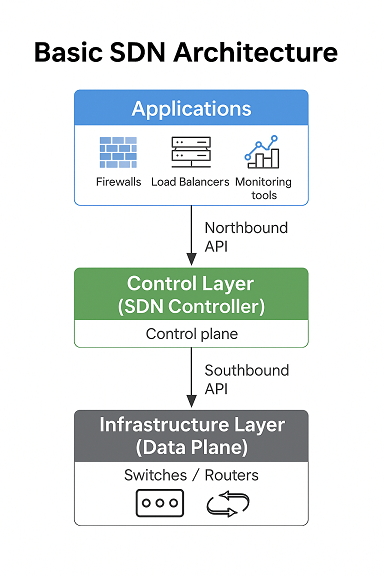
  • SDN Applications: These express the intent or policy that should be enforced in the network — such as load balancing, access control, or routing optimizations.
  • SDN Controller: The brain of the architecture. It receives requests from applications and translates them into instructions for the infrastructure.
  • Network Infrastructure (Data Plane): The physical and virtual switches and routers that forward packets based on the controller's guidance.

Control Plane vs. Data Plane

Traditionally, the control plane and data plane are housed within each device — every switch and router maintains its own forwarding decisions. SDN breaks this pattern. The control logic is extracted and centralized, which simplifies policy enforcement and increases network agility.

Southbound and Northbound APIs

Communication in SDN is mediated by APIs:

  • Southbound APIs: These connect the controller to the forwarding devices. OpenFlow is the leading standard here in 2013.
  • Northbound APIs: These enable SDN applications to program the controller. Though not yet standardized, RESTful APIs are becoming common.

OpenFlow: The Leading Protocol

OpenFlow allows the controller to interact directly with the forwarding plane of switches and routers. It enables dynamic traffic management and offers fine-grained control over packet flows. In 2013, vendors like HP, NEC, Brocade, and Big Switch are shipping OpenFlow-compatible hardware.

Illustrative Architecture

SDN Architecture Diagram

Virtualization and SDN

Server virtualization has become ubiquitous in data centers. SDN extends this flexibility to the network layer. Solutions like VMware NSX and Open vSwitch (OVS) illustrate how SDN supports network abstraction in virtualized environments. This is key for VM mobility, multi-tenancy, and dynamic service chaining.

SDN Controllers

Controllers vary in design. Some are distributed (e.g., ONOS, Floodlight), others centralized (NOX, Beacon). Key capabilities include topology discovery, flow management, path computation, and failover. Most are open-source and programmable via Java, Python, or REST APIs.

Application Scenarios

  • Data Center Automation: Automate network provisioning alongside virtual machine spin-up.
  • Policy Enforcement: Apply consistent access controls across dynamic environments.
  • WAN Optimization: Steer traffic based on application type or performance requirements.

Security Implications

Centralizing control logic introduces new attack surfaces. If the controller is compromised, so is the network. Design strategies must include redundancy, TLS encryption, access controls, and monitoring of API interactions. Defense in depth is non-negotiable in SDN environments.

Challenges in 2013

  • Controller Performance: Can one controller manage large-scale traffic in real-time?
  • Hybrid Deployments: Mixing SDN and traditional networks raises operational complexities.
  • Northbound API Standardization: Lack of uniformity hinders application portability.

Industry Ecosystem and Progress

The Open Networking Foundation (ONF) has accelerated momentum around SDN standards, particularly OpenFlow. Meanwhile, Cisco’s ONE and Juniper’s Contrail demonstrate vendor-specific SDN architectures. The community is growing fast — startups, open-source initiatives, and traditional vendors are investing heavily.

Design Considerations and Future Proofing

Architects evaluating SDN should weigh:

  • Controller placement and redundancy strategies
  • Interoperability with legacy protocols (e.g., BGP, STP)
  • Tooling for orchestration and monitoring (e.g., Puppet, Chef)
  • Scalability of southbound connections (10K+ flows/sec)

Conclusion: Foundational But Evolving

SDN introduces fundamental changes in how we think about networking. This post covered the architectural pillars and operational motivations. In Part 2, we explore real-world deployments, controller platforms, and the growing vendor ecosystem surrounding SDN.


Eduardo Wnorowski is a network infrastructure consultant and Director.
With over 18 years of experience in IT and consulting, he designs high-performance network environments that align with business agility, security, and scalability goals.
Linkedin Profile

Network Reliability Engineering: Turning Modern Network Operations into a Discipline Network Reliability Engineering: Turning ...