Showing posts with label iBGP. Show all posts

Thursday, October 1, 2015

Understanding Route Reflectors in Large BGP Deployments

October 2015 - Reading time: 9 minutes

In large-scale BGP deployments, route reflectors (RRs) are indispensable for simplifying iBGP mesh complexity. Without them, a full mesh of iBGP sessions between all routers in an autonomous system would be required, leading to exponential growth in configuration and maintenance.

Why Route Reflectors?

As BGP scales up in large service provider or enterprise networks, managing full mesh iBGP becomes impractical. Route Reflectors allow certain routers to reflect BGP routes to clients, reducing the number of peerings required.

Unlike confederations, RRs operate within a single AS and maintain simplicity in deployment. They can significantly reduce the control plane load when designed carefully.

Basic Operation

A Route Reflector receives routes from one client and reflects them to other clients or non-clients. It adds a CLUSTER_LIST and ORIGINATOR_ID attribute to track the path and prevent loops. Understanding these mechanisms is crucial to proper RR design.

Designing Route Reflector Topologies

Several design models exist: centralized, hierarchical, and mesh of RRs. Each comes with trade-offs in fault tolerance, convergence speed, and scalability. For instance, centralized RRs are easy to manage but create single points of failure unless redundancy is added.

Best Practices for RR Design

  • Redundancy: Always deploy at least two route reflectors per cluster to avoid single points of failure.
  • Symmetry: Clients should peer with multiple RRs to ensure symmetrical routing and high availability.
  • Load Distribution: Avoid overloading a single RR by balancing client assignments.
  • Loop Prevention: Ensure proper configuration of CLUSTER_IDs and monitoring of CLUSTER_LIST growth.

Common Pitfalls

Misconfiguring cluster IDs or failing to monitor ORIGINATOR_ID propagation can lead to routing loops. Also, reflecting routes across clusters without awareness can introduce unwanted paths.

RRs should never perform policy manipulation without understanding the implications. Excessive route filtering or redistribution can destabilize the iBGP topology.

RR Placement and Hardware Considerations

Though RRs do not forward traffic, their CPU and memory demands can be high in dynamic environments. Choosing the right platform is critical. Software routers with ample resources or control-plane-focused devices often serve as RRs.

Monitoring and Troubleshooting

Use tools like show ip bgp, show ip bgp neighbors, and route analytics platforms to track route reflection behavior. SNMP and telemetry can help identify delays in route propagation or instability.

Logging CLUSTER_LISTs and reviewing ORIGINATOR_IDs can be a powerful troubleshooting method in complex topologies.

Beyond Basics: Advanced Considerations

Operators often deploy route reflectors in MPLS core networks, requiring awareness of label distribution protocols. Additionally, designs using multi-level RR topologies introduce latency and complexity but are necessary at scale.

In data centers or overlay networks, RRs also play roles in BGP EVPN, where route reflection must interact properly with VXLAN and MAC address propagation mechanisms.

Conclusion

Route reflectors are not just an optimization—they are an architectural necessity in large BGP networks. Proper design, monitoring, and policy management ensure scalability and stability. As with any BGP deployment, clear documentation and lab validation are key to long-term success.


Eduardo Wnorowski
With over 20 years of experience in IT and consulting, he brings deep expertise in networking, security, and infrastructure. Eduardo helps businesses scale their network operations with robust design practices and real-world knowledge.
LinkedIn Profile

Wednesday, May 20, 2015

Scaling BGP – Part 2: Design and Implementation of Route Reflectors

May 2015 - Reading Time: 12 minutes

Introduction

In Part 1, we explored the motivations behind scaling BGP in large networks and examined the limitations of a full-mesh iBGP topology. Now we shift our focus to the next phase: designing and implementing Route Reflectors (RRs). Route Reflectors reduce iBGP mesh complexity while preserving path visibility and control—if configured correctly. But the design process comes with challenges that impact convergence, redundancy, and policy enforcement.

What Is a Route Reflector?

A Route Reflector is a BGP router that can reflect routes learned from one iBGP peer (client) to another. This deviates from the standard iBGP rule that says routers must not advertise iBGP-learned routes to other iBGP peers. The mechanism is defined in RFC 4456.

There are three types of peers in an RR topology:

  • Clients: iBGP neighbors from which the RR learns and to which it reflects routes.
  • Non-Clients: iBGP neighbors of the RR that are not clients—RRs do not reflect routes between them.
  • Other RRs: In large deployments, RRs peer with each other to propagate routes further.

Basic Topologies and Design Variants

Designing an RR topology is not just about picking one or two routers to act as reflectors. It requires careful consideration of failure domains, redundancy, and route availability. The most common approaches include:

1. Single Route Reflector

This is the simplest and least fault-tolerant configuration. All iBGP clients peer with one RR. If the RR fails, the clients are isolated. While not recommended for production, it's still found in labs and small networks.

2. Dual Route Reflectors

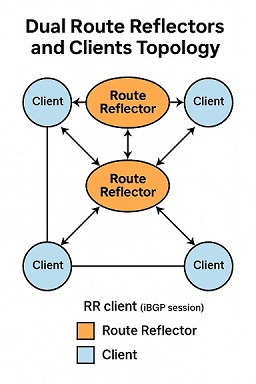
Two RRs provide redundancy. Clients peer with both. This is more resilient, but comes with new challenges in route consistency. Clients may receive different best paths from each RR, depending on IGP metrics and RR state.

3. Hierarchical Route Reflectors

In very large-scale environments, RRs may be organized in tiers—core, aggregation, and access. Clients peer with local RRs, and RRs peer among themselves in a hierarchical fashion. This enables scalability while limiting the failure domain of any one RR.

4. Confederation + Route Reflectors

In very large ISPs or MPLS VPN deployments, Confederations are combined with RRs for even greater scalability. Each confederation sub-AS may have its own RRs, with inter-sub-AS peering maintained at the border.

iBGP Client Configuration: An Example

Let's take a simple topology with two route reflectors and three clients. Here's a configuration snippet from a Cisco device acting as a client:

router bgp 65000
 bgp log-neighbor-changes
 neighbor 10.0.0.1 remote-as 65000
 neighbor 10.0.0.1 route-reflector-client
 neighbor 10.0.0.2 remote-as 65000
 neighbor 10.0.0.2 route-reflector-client

The 'route-reflector-client' command tells the router that these neighbors can reflect routes to it. On the RR side, the same directive applies for each client peer.

Design Considerations

1. IGP Consistency

RRs select best paths based on BGP attributes and IGP metrics. If your IGP cost to clients varies significantly, your best path may be inconsistent across RRs. Keep the IGP stable and symmetric where possible.

2. BGP Attributes Preservation

By default, RRs do not modify most BGP attributes, but some attributes (like ORIGINATOR_ID and CLUSTER_LIST) are added to prevent loops. Be aware of how these attributes affect downstream policy and selection.

3. Convergence Tradeoffs

Reflectors reduce the number of iBGP sessions but may slow down convergence compared to full mesh. Route withdrawals may propagate more slowly. You may need to tune BGP timers or deploy BGP PIC (Prefix Independent Convergence) for improvement.

4. Cluster-ID Strategy

Each RR cluster must have a unique Cluster-ID to avoid loops. When multiple RRs are deployed in the same cluster, they must share the same Cluster-ID. Mismatches can cause routing blackholes or path inconsistencies.

Testing and Visibility

To validate your RR setup, use the following techniques:

  • Check the BGP table for reflected prefixes using show ip bgp or show bgp ipv4 unicast.
  • Inspect the CLUSTER_LIST and ORIGINATOR_ID fields for path loop prevention.
  • Test route failover scenarios to ensure redundancy behaves as expected.
  • Use traceroute or ping with loose source routing to simulate asymmetric paths.

Operational Pitfalls

Some common issues when deploying RRs include:

  • Clients accidentally configured as non-clients, leading to missing routes
  • Route dampening policies incorrectly applied at the RR, causing route flaps
  • Uneven path selection due to differing IGP metrics or missing MEDs
  • Failure to reflect loopback reachability, breaking next-hop resolution

These can be addressed with a combination of peer-template configurations, strict prefix filtering, and route policies tailored for RR logic.

Visualization

RR Topology Example

Conclusion

Route Reflectors offer a scalable and efficient way to manage iBGP topologies, especially in networks that grow beyond a few dozen routers. However, they are not a silver bullet. Design decisions around redundancy, attribute propagation, and convergence must be deliberate. In Part 3, we’ll explore best practices and performance tuning techniques to optimize your BGP design further.


Eduardo Wnorowski is a network infrastructure consultant and architect.
With over 20 years of experience in IT and consulting, he builds scalable, high-performance environments for enterprise and service provider networks.
Connect on Linkedin

Friday, March 20, 2015

Scaling BGP – Part 1: The Case for BGP Scalability in Large-Scale Networks

March 2015   •   Reading time: 12 minutes

Why BGP Needs to Scale

As enterprises and service providers expand their networks to meet the demands of global users, the Border Gateway Protocol (BGP) faces new challenges. In its original form, BGP wasn't designed for the massive scale it now supports. From sprawling data centers to regional ISPs, the protocol's default mechanisms often strain under the complexity of large-scale topologies.

Today’s post examines the limitations of traditional BGP in modern networks and sets the stage for why scalable mechanisms such as Confederations and Route Reflectors (RRs) have become essential.

Recap: What is BGP?

BGP is a path vector protocol that governs inter-domain routing across the internet. It’s used to exchange routing information between autonomous systems (ASes), providing a framework for routing policy, reachability, and route selection based on attributes such as AS_PATH, MED, LOCAL_PREF, and more.

Although BGP is considered a protocol of last resort due to its manual tuning, it's the backbone of global routing. Within an AS, Interior BGP (iBGP) allows routers to share information internally, which becomes critical as networks grow in size and complexity.

The Problem with Full Mesh iBGP

By default, iBGP requires a full mesh of peerings among all BGP-speaking routers in the same AS. This ensures all routers receive complete routing information, but the scalability limits become apparent quickly.

  • Each router must peer with every other router.
  • This results in n(n-1)/2 sessions, where n is the number of routers.
  • Administrative overhead increases exponentially.
  • Router CPU and memory consumption rises with each additional peer.

In practice, full mesh becomes unmanageable once you surpass even 10–20 routers. This is where hierarchical design becomes necessary.

Case Study: ISP with 75 Core Routers

Imagine an ISP operating with 75 routers across regional cores, border routers, and peering points. A full mesh of 75 iBGP routers would require 2,775 BGP sessions. Maintaining this at scale is not only inefficient—it’s nearly impossible.

Beyond the session count, consider the propagation delays, route processing queues, and convergence complexity. In such environments, full mesh is not viable.

Requirements for Scalable BGP

To scale BGP within an AS, network architects need mechanisms that:

  • Reduce the number of required peerings
  • Maintain loop-free and complete route visibility
  • Support policy control and traffic engineering
  • Ensure fast convergence and fault isolation

Two main solutions have emerged to solve these challenges:

  • Route Reflectors (RRs): A mechanism to centralize iBGP route distribution.
  • Confederations: A way to split a single AS into smaller sub-ASes for iBGP scalability.

Preview: What’s Next in the Series

This post lays the groundwork for the upcoming two parts in this deep dive series:

  1. Part 2: Design and Implementation of Route Reflectors
  2. Part 3: Leveraging BGP Confederations for Hierarchical Control

Each of these scaling techniques comes with its own design considerations, pitfalls, and operational trade-offs. Understanding when and how to use them is critical to maintaining a scalable and robust network.


💡 Pro Tip: Start documenting iBGP peerings and dependencies before implementing Route Reflectors. Visibility is the first step to control. 


Eduardo Wnorowski is a network infrastructure consultant and Director.
With over 20 years of experience in IT and consulting, he designs routing architectures that scale with performance and policy control.
Connect on Linkedin

Sunday, July 1, 2012

Scaling BGP in Enterprise and SP Environments: Route Reflectors, Confederations, and Policy Control

July 2012 - Reading time: 8 min

As networks grow larger and more interconnected, especially in Service Provider (SP) and multi-site enterprise environments, the scalability of BGP (Border Gateway Protocol) becomes critical. In traditional iBGP (Internal BGP) configurations, every BGP speaker must maintain a full mesh of connections with every other iBGP peer to ensure routing information is exchanged properly. However, this model quickly becomes unsustainable as the number of routers increases.

The Full Mesh Limitation

Standard iBGP requires that all BGP routers in an autonomous system (AS) be fully meshed. This is necessary to prevent routing loops, as BGP does not advertise iBGP-learned routes to other iBGP peers by default. Unfortunately, the number of required sessions grows quadratically (n*(n–1)/2), making full mesh management a burden in large environments.

Route Reflectors

One common solution is the use of Route Reflectors (RRs). A Route Reflector acts as a central point that reflects routes learned from one iBGP peer to other iBGP peers. This eliminates the need for a full mesh, reducing the number of sessions while maintaining loop-free operation with the use of cluster IDs and originator IDs.

In practice, networks often deploy multiple RRs for redundancy, with clients peering only with their local RRs. Non-client routers still peer with each other in select topologies for additional resiliency. Loop prevention is achieved by tagging reflected routes with the originator ID and cluster list to prevent re-advertisement back to the source.

BGP Confederations

Another powerful scaling technique is the use of BGP Confederations. A confederation breaks an AS into multiple sub-ASes. These sub-ASes peer with each other as though they were external BGP sessions (eBGP), while internally they run iBGP. To the outside world, the confederation appears as a single AS.

Confederations allow more flexible policy control and more granular administrative boundaries, especially in multi-division enterprises or SP core networks. They also reduce iBGP overhead by reducing the scope of required full mesh inside each sub-AS.

Design Considerations

When choosing between Route Reflectors and Confederations, it’s important to consider:

  • Network size and complexity: RRs are easier to deploy and manage in most enterprise networks. Confederations are better suited to very large or politically segmented networks.
  • Policy enforcement: Confederations allow more policy granularity between sub-ASes. RRs have less natural policy segmentation unless you combine them with BGP communities or route maps.
  • Interoperability: RRs are widely supported and straightforward. Confederations require tight control of AS path prepending and can confuse third-party visibility if not carefully configured.

Policy Control with Route Maps and Communities

Regardless of scaling mechanism, policy control remains crucial. Tools like route maps, prefix lists, and BGP communities are essential to enforce route filtering and path selection. Communities in particular are helpful in influencing decisions across RRs and can be used to tag routes with desired behaviors like “no-export”, “local-preference”, or custom policies.

In some environments, tagging with BGP communities is automated and integrated with provisioning systems, allowing for sophisticated, dynamic routing decisions that adapt to service-level agreements (SLAs), cost models, or even traffic engineering policies.

Real-World Deployment Tips

  • Use redundant Route Reflectors and ensure they don’t reflect to each other to avoid routing loops.
  • Monitor cluster list lengths to detect suboptimal route paths.
  • When using Confederations, document sub-AS boundaries clearly and ensure correct AS path prepending.
  • Implement extensive logging and validation during convergence testing to understand the behavior of policies and route propagation.
  • Pair Route Reflectors with route filtering logic to avoid accidental advertisement of internal prefixes.

Conclusion

BGP is inherently scalable, but without careful design, large-scale deployments can become fragile. Route Reflectors and Confederations are both powerful tools to mitigate iBGP scaling issues, but they require attention to detail in design, policy control, and testing. When combined with smart policy enforcement and operational discipline, they enable the kind of flexible, scalable, and resilient routing that modern enterprise and SP environments demand.


Eduardo Wnorowski is a network infrastructure consultant and technologist.
With over 17 years of experience in IT and consulting, he brings deep expertise in networking, security, infrastructure, and transformation.
Connect on Linkedin

Network Reliability Engineering: Turning Modern Network Operations into a Discipline Network Reliability Engineering: Turning ...